

Average kWh Electricity usage for Small Business in Ireland
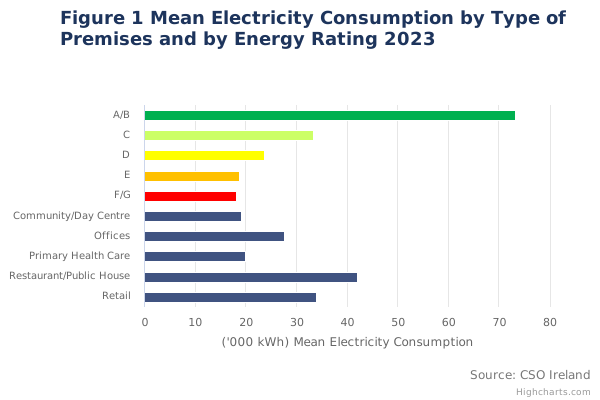
Irish business energy consumption in 2023 saw electricity usage rise by 7%, while natural gas consumption fell by 7%, following a 2022 trend of increased overall consumption, the CSO reports. Key consumption sectors include services (42% in 2021) and industry. Small businesses typically use 15,000–25,000 kWh annually, though this varies widely by industry. The highest electricity consumption per square metre in 2023 was in Restaurants/Public Houses (195 kWh/m2), followed by Retail (138 kWh/m2), Offices (80 kWh/m2), Primary Health Care buildings (76 kWh/m2) and Community/Day Centres (68 kWh/m2).
Typical Consumption Profiles (Annual)
- Coffee Shops: ~25,000 kWh
- Hairdressers: ~60,000 kWh
- Restaurants: ~90,000 kWh
- Barbers: ~10,000 kWh
Small change big money saving opportunity
I spend most of my week walking through Irish businesses with a clipboard in one hand and an electricity bill in the other. Cafés before the morning rush. Hair salons between appointments. Restaurants during that quiet hour after lunch when the kitchen finally cools down.
And almost every visit starts the same way.
Someone slides a bill across the table and asks,
“Is this normal? Are we using too much electricity?”
What I Usually See on the Ground
When I audit small businesses across Ireland, the majority fall into a fairly tight band: 15,000 to 25,000 kWh a year. That’s the norm for many cafés, salons, and service-based businesses.
But “normal” has a wide edge. I’ve audited premises using as little as 5,000 kWh and others pushing 90,000 kWh, and in nearly every case the reason is obvious once you step onto the floor, opening hours, heating type, kitchen equipment, refrigeration, or ventilation.
Numbers only tell half the story. Walking the site tells the rest.
Patterns by Business Type
Over time, certain patterns repeat themselves. When I review bills alongside site visits, these averages show up again and again:
Patterns by Business Type
Over time, certain patterns repeat themselves. When I review bills alongside site visits, these averages show up again and again:
- A coffee shop typically lands around 25,000 kWh per year
- A hairdresser often sits closer to 60,000 kWh, mainly due to dryers and electric water heating
- A restaurant regularly reaches 90,000 kWh, driven by kitchens that never truly switch off
- A barber, by contrast, is often near 10,000 kWh
These aren’t targets or limits they’re reference points. The moment I see electric space heating, laundry cycles running all day, pizza ovens, cold rooms, or late-night trading, I expect the numbers to climb. And that’s fine if the tariff matches the load.
Making Sense of the Bills
When business owners struggle to interpret their bills, I convert the annual figure into something more tangible.
If a site uses 15,000 to 25,000 kWh a year, that usually means about 1,250 to 2,080 kWh a month, or roughly 41 to 68 kWh a day.
A larger operation at 50,000 kWh annually is closer to 4,170 kWh per month, or 137 kWh per day.
Once owners see those daily numbers, the penny often drops. They can suddenly link consumption to opening hours, prep time, or equipment left running overnight.
The Moment We Find the Real Problem
Here’s the part many people don’t expect.
In a large number of audits, usage isn’t the main issue. The rates are.
I regularly find well-run businesses on out-of-contract electricity prices, paying far more per kWh than they need to. No alarms. No warning letters. Just silent margin erosion.
I’ll do a quick calculation at the table:
Annual cost equals kWh used × unit rate, plus the standing charge.
Savings come from the gap between the old rate and a new, market-aligned one.
At typical out-of-contract rates say €0.42 per kWh switching to a €0.32 contract can mean:
- €1,000 a year saved at 10,000 kWh
- €2,500 at 25,000 kWh
- €5,000 at 50,000 kWh
No equipment changes. No disruption. Just fixing the contract.
Our Services
Energy saving events and workshops
We believe that with the awareness of the staff and changing behaviour you can save more than 5 percent of your annual energy bills.
Energy Saving Discussion session
You can get an energy consultation meeting with one of our engineers to discuss the process and discover low/no cost saving for your premisses.
Energy statement
We provide data-driven Professional Energy Statements that translate complex consumption patterns into clear, actionable insights for your business's bottom line.
Non-Domestic BER (Building Energy Rating) assessment
A Non-Domestic BER (Building Energy Rating) assessment is a legal requirement in Ireland for almost all commercial buildings—such as offices, retail units, warehouses, and hotels, when they are being constructed, sold, or rented.
SSEA Energy audit
As a registered energy auditors, we conduct fully-funded SSEA Energy Audits that provide your SME with a €2,000 SEAI voucher to identify high-impact savings at zero cost to your business.
Grant Advisory & Funding Procurement
We help your business navigate and secure a wide range of available funding—from €2,000 audit vouchers to €120,000 upgrade grants and we will sit down with you to discuss exactly which schemes best fit your specific goals.